Language selection

Search


Top of page

Artemis II daily logbook

This page is updated daily. Come back often!

Splashdown! Jeremy Hansen back on Earth!
Day 10
Ok

After travelling over 1 million kilometres to the Moon and back, the Artemis II crew returns home. Over the course of 10 days, Canadian Space Agency astronaut Jeremy Hansen and NASA astronauts Christina Koch, Victor Glover, and Reid Wiseman became the first people to travel to the Moon since 1972. They travelled farther from Earth than any humans in history, surpassing the record held by Apollo 13. The crew tested technology, performed science experiments, and took incredible photos of the lunar surface. (Credits: CSA, NASA)

Transcript

Canadian Space Agency (CSA) astronaut Jeremy Hansen and his Artemis II crewmates, NASA astronauts Reid Wiseman, Victor Glover and Christina Koch, splashed down at about 100 km off the coast of San Diego, California, after having travelled over 1.1 million km to the Moon and back in nearly 10 days. The recovery team from NASA and the U.S. Navy were standing by to welcome the crew home.

At the CSA, guests joined employees and media to highlight the contribution of Jenni Gibbons and Jeremy Hansen and celebrate the end of the historic mission.

The event was hosted by two CSA experts, Kumudu Jinadasa and Timothy Haltigin. After a few nail-biting moments, the crowd erupted into applause at splashdown.
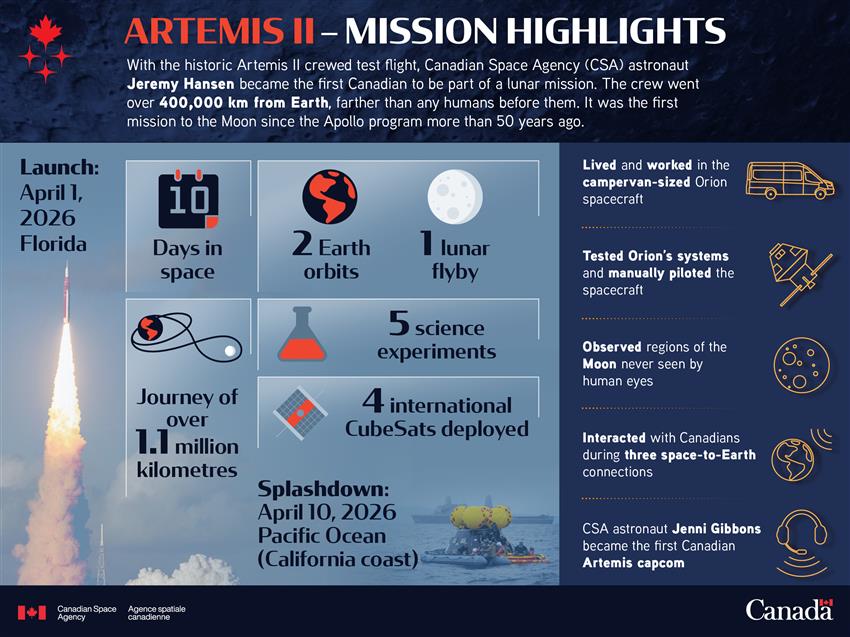
Artemis II Mission Highlights – Infographic

Text version

This infographic showcases highlights of the Artemis II crewed test flight from to . (Credit: CSA)

A detailed choreography

The Orion crew module successfully separated from the European Space Agency's service module at 7:33 pm ET, marking the beginning of the final phase of the Artemis II mission.

Following separation, the crew module performed a brief burn to set the proper angle for atmospheric re-entry while the service module harmlessly burnt up in Earth's atmosphere.

Orion encountered the atmosphere at . Earth's atmosphere slowed the spacecraft from about 43,000 km/h (or 35 times the speed of sound) to about 500 km/h at the beginning of the parachute sequence. Three small parachutes first pulled away the forward bay cover, which is at the top of the crew module and protects the top portion of Orion and its parachutes until re-entry. Two drogue parachutes then deployed about 7 km above Earth to stabilize the spacecraft. They were followed by three pilot parachutes that extracted the main parachutes between a bit below 2 km from Earth, slowing Orion to a safe splashdown speed of less than 30 km/h.

Upon splashdown, five bright‑orange, helium‑filled bags were automatically deployed on top of the spacecraft. These airbags ensured Orion remained upright – or could be righted within minutes – so that communications, ventilation, and crew health protections remained fully functional during recovery operations.

Recovering the crew

Medical teams completed initial health checks of the crew shortly after retrieval. With the crew safely aboard the ship, thorough medical exams were done, and recovery teams turned their attention to securing the Orion spacecraft.

Recovering Orion

Immediately after splashdown, flight controllers at NASA's Johnson Space Center conducted a series of open‑water tests, gathering additional data on Orion's performance after re-entry. These checks included assessments of the spacecraft's thermal protection system, avionics, and external hardware following the extreme heating and dynamic forces of atmospheric entry. Recovery personnel also captured detailed imagery of the spacecraft before initiating the retrieval sequence.

After recovery, the capsule was safely towed to USS Murtha. It was positioned and locked into the specially designed cradle inside the ship's well deck and transported to Naval Base San Diego, where it will be offloaded and prepared for return to NASA's Kennedy Space Center (KSC) in Florida. At KSC, technicians will perform a detailed inspection of the spacecraft, retrieve onboard data, remove payloads, and begin post‑flight analysis that will inform future Artemis missions.

What's next

After a few hours of rest in San Diego, the crew will fly back on to Ellington Field in Houston.

In the coming days and weeks, they will participate in many debrief sessions and medical evaluations, including blood draws and other procedures to evaluate the impact of the flight on their body and to support the scientific research conducted during the mission.

Of his experience, Jeremy stated:

"Artemis II has been an amazing, profound, and beautiful experience, but also very humbling. It has been an honour representing Canada on this mission. I am forever grateful for the hard work of so many Canadians that made this historic mission a reality."

In the months ahead, the crew will participate in a number of events in the United States and Canada to thank those involved in person, share their mission with the public, and discuss how Artemis II brings us closer to returning astronauts to the lunar surface and pushing farther into the solar system than ever before.

Continue to follow the CSA on social media for updates about post-flight activities. Thank you for joining us on the historic Artemis II journey!
Preparing to splash down
Day 9
Ok

On flight day 9 of the Artemis II mission, the crew prepared their Orion spacecraft for splashdown. They stowed equipment to ensure all items are secured for re-entry, installed their seats and studied re-entry procedures. (Credits: CSA, NASA)

Transcript

As the Orion spacecraft continues its journey toward Earth, the Artemis II crew spent the day preparing for the splashdown. They reviewed cabin configuration procedures, ensuring the crew is ready for the upcoming sequence of return operations, including putting their spacesuits on, stowing equipment and reconfiguring their seats.

Canadian Space Agency (CSA) astronaut Jeremy Hansen reviewed the final targeting, burn execution procedures, and monitoring responsibilities ahead of the final two return trajectory burns planned to further refine Orion's path toward Earth.

The astronauts went through their entry checklist of all the tasks they need to perform before splashdown and prepared for the handover of communications from the Deep Space Network to NASA's Tracking and Data Relay Satellite System as the spacecraft approaches Earth.

Join the CSA splashdown livestream

On , we invite you to tune into the CSA's splashdown livestream on YouTube or Facebook as of ET. The event will follow Orion and its crew as they re-enter Earth's atmosphere at 32 times the speed of sound up until they splash down in the Pacific off the coast of San Diego, California. The crew will later be recovered by NASA and the U.S. Navy, ending this historic mission around the Moon.

We encourage you to gather with family and friends to watch and celebrate the return of Jeremy Hansen – and make it a memorable moment by using some of the activities, games and entertainment in our watch party guide. Be sure to also share your pride on social media and tag the CSA in your posts!

A call with the Prime Minister of Canada
Day 7 – 8
Ok

On , the Artemis II crew mostly had a rest day ahead of their journey home. The crew spoke with science officers about their lunar flyby and received a call from their astronaut colleagues abord the International Space Station. The next day, they spoke with Mark Carney, Canada's Prime Minister; Mélanie Joly, Minister of Industry and Minister responsible for Canada Economic Development for Quebec Regions; as well as Air Cadets and students. (Credits: CSA, NASA)

Transcript

Following a successful lunar flyby on flight day 6, the Artemis II crew is on their way back to Earth after taking a well-deserved off-duty day to recover after an intensive period of operations. One of the only activities on schedule was a post-flyby discussion with scientists about the lunar surface observations.

View some of the first flyby images

The crew also had the opportunity to talk to their astronaut colleagues aboard the International Space Station (ISS) during a 15-minute audio call: NASA astronauts Jessica Meir, Jack Hathaway, and Chris Williams, and European Space Agency (ESA) astronaut Sophie Adenot. They talked about their respective mission experiences and what was on their menu – the spicy green beans seemed to be a crowd pleaser on both spaceships!

Speaking with special guests

Jeremy spoke last night to the Honourable Mark Carney, Prime Minister of Canada; the Honourable Mélanie Joly, Minister of Industry; other high-level guests; students and Air Cadets. The event was hosted by Joshua Kutryk, Canadian Space Agency (CSA) astronaut and next Canadian to fly to the ISS. Their colleague Jenni Gibbons was at the capcom console to kick off the event.

The Prime Minister and the crew enjoyed some light banter about their wake-up songs and maple syrup. Earlier that day, the crew had awoken to "Under Pressure" by Queen, and a cheerful message from CSA President Lisa Campbell and CSA employees. But the conversation also covered more serious topics such as the risks associated with the mission and the importance of teamwork and collaboration. Jeremy mentioned that he was really proud of Canada, that it was our country that did the groundwork and created the opportunity for him to be part of this flight. Christina Koch echoed a message that has been resonating throughout their journey:

"When you go together, when you bring in partners and different collaborators that are all excited about the same mission, but have different talents, you can go so much farther."

On his journey to the Moon, Jeremy also carries knowledge and traditional teachings from Elders and Knowledge Keepers from numerous Indigenous communities who helped him prepare for his mission. His personal mission patch was graciously created by Anishinaabe artist Henry Guimond of Sagkeeng First Nation in Manitoba. While the patch contains elements of Anishinaabe culture that do not reflect all First Nations, Inuit and Métis cultures, the patch is Jeremy's way to recognize the importance of traditional knowledge and Indigenous Peoples in Canada.

In this spirit, Elder Bryan Akwirente Deer of the Bear Clan of the Mohawk Nation of Kahnawake opened the event with a touching ceremonial blessing, rooted in Indigenous traditions and reconciliation practices.

Questions were also asked later in the event by Air Cadets, a program that Jeremy credits with putting him on the path to space, and students, selected by STEM organizations Let's Talk Science and Actua.

Adjusting Orion's path towards Earth

Artemis II continued its journey as the crew completed the mission's first return trajectory correction burn. Orion's service module, provided by ESA, used its propulsion system to place the spacecraft precisely on its intended return-coast trajectory.

Counteracting dizziness and fainting

Jeremy and Christina evaluated the orthostatic intolerance garment, a specialized piece of equipment designed to help astronauts maintain blood pressure and circulation during the transition back to Earth's gravity. Reid Wiseman and Victor Glover repeated the same process later in the day.

After extended periods in microgravity, some astronauts experience orthostatic intolerance when returning to Earth, a condition that makes it difficult to stand upright without dizziness or fainting. The garment provides lower body compression to counteract this effect and support a safe return.

During the test, the crewmembers assisted one another with putting on and removing the garments. They took body circumference measurements and completed questionnaires documenting the ease of putting on and removing, the time required for each step, and the overall fit and comfort of the garment. These results will be reviewed by NASA flight surgeons and spacesuit technicians to confirm proper sizing and make any necessary adjustments ahead of entry day.

On the way home

On their journey home, the crew will continue to monitor spacecraft systems, support ongoing research, and prepare for the next major milestones: the splashdown, which is scheduled for .

A unique and poignant view of the Moon
Day 6
Ok

The Artemis II crew witnessed the near and far sides of the Moon during their lunar flyby, surpassing Apollo 13's distance record and becoming the humans who have flown the farthest from Earth. Using their geology training, they were the eyes of a team of scientists. They observed and photographed lava flows, lunar features and craters, two of which they proposed names for. But most of all, the four astronauts shared their humanity with people back on Earth. (Credits: CSA, NASA)

Transcript

A basketball held at arm's length – that is what the Moon looked like to the Artemis II crew as Orion flew at its closest distance to the Moon's surface. They were the first humans to see, with the naked eye, parts of the Moon's far side – the side that always faces away from Earth. The Sun, the Moon and the Orion spacecraft were aligned such that the crew saw about 20% of the Moon's far side.

With real-time data analysis and guidance provided by a team of scientists with expertise in impact cratering, volcanism, tectonism, and lunar ice, for about seven hours the crew observed and photographed geological features like impact craters and ancient lava flows, as well as regions like the Orientale basin. It is identifiable by the dark splotches that cover its surface.

"It is blowing my mind what you can see with the naked eye from the Moon right now. It's just unbelievable!" said Canadian Space Agency (CSA) astronaut Jeremy Hansen. The crew thoroughly described details of the Moon, including shades of browns and blues that can be picked out with human eyes and can help reveal the mineral composition of a feature and its age.

The Artemis II astronauts and CSA astronaut Jenni Gibbons, who was the capcom supporting the crew from Mission Control, used their geology training to describe surface textures, shapes, and colours, providing valuable data for future exploration of the Moon.

Breaking the distance record of Apollo 13

The four astronauts of Artemis II made history when they surpassed the record for human spaceflight's farthest distance previously set by the Apollo mission in . Jenni Gibbons marked the moment by delivering a few words from NASA's Mission Control Center. Jeremy Hansen then shared sentiments on behalf of the crew, honouring past space explorers and challenging the current and future generations to go even farther.

Ok

The Artemis II crew surpassed the distance record set during Apollo 13 in  and became the humans who have travelled the furthest in space (406,773 km). CSA astronaut Jenni Gibbons marked the occasion from the capcom console in Mission Control. CSA astronaut Col. Jeremy Hansen then spoke on behalf of the crew to honour past space explorers and challenge future generations to go even further. (Credits: CSA, NASA)

Transcript

Bigger than just science

In a very emotional moment that ended in a heartfelt group hug, the crew suggested naming two craters on the Moon. Those names were Integrity, in honour of their spacecraft, and Carroll, as a tribute to Commander Reid Wiseman's late wife. After this mission is complete, the crater name proposals will be formally submitted to the International Astronomical Union, which governs the naming of celestial bodies and their surface features.

Thirty science targets

The NASA science team had identified 30 targets for the crew to observe and photograph. The crew was particularly excited to observe the Orientale basin, an over 900-km-wide crater about as big as Alberta that straddles the Moon's near and far sides. Orientale was fully illuminated and visible as Orion approached the Moon. This 3.8-billion-year-old crater formed when a large object struck the lunar surface and retains clear evidence of that collision, including dramatic topography in its rings. The crew studied Orientale's features up close and from multiple angles as they passed by.

For about an hour, they also saw a solar eclipse as Orion, the Moon and the Sun aligned. The Sun disappeared behind a mostly darkened Moon, which gave the opportunity to study the solar corona – the Sun's outermost atmosphere – as it glows around the lunar edge. They also watched for lunar dust rising from the surface and flashes of light from micrometeoroids striking the Moon, which could offer insight into potential hazards on the Moon.

The flyby in numbers
  • About 7 hours of lunar surface observation
  • 30 targets for the crew to observe and photograph
  • Orion entered and exited the lunar sphere of influence at about 66,100 km from the Moon
  • ET – Maximum distance from Earth: 406,773 km, surpassing the Apollo 13 distance record by about 6,600 km
  • Distance beyond the far side of the Moon: about 6,544 km

Isolated from their fellow 8 billion humans on Earth

When Orion passed behind the Moon, there was a planned communications blackout for about 40 minutes as the Moon blocked the radio signals needed for the Deep Space Network to connect with the spacecraft. During that period, the four astronauts had no means to communicate with Earth. Moments before, Jeremy said to his family:

"It's extraordinary to be on the far side of the Moon right now, looking back at the Earth. Just wanted to say hi! Love you guys!"

As Earth set below the lunar horizon, the crew paused to reflect on what was achieved and celebrated by sharing Canadian maple cream cookies. Similar blackouts occurred during the Artemis I and Apollo missions. Once Orion re-emerged from behind the Moon, Earth re-emerged at Earthrise from the opposite edge, and the network quickly reacquired its signal and restored contact with NASA's Mission Control.

On the horizon

Tomorrow will be a well-deserved rest day for the crew, with minimal activities on the agenda after an extremely busy beginning of the mission.

On , it will be the last opportunity for Jeremy to speak live to Canadians from the vicinity of the Moon as he answers questions from Canadian youth in the presence of special guests assembled at CSA headquarters. You can watch the event live (or the recording later) on the CSA's YouTube channel and Facebook page.

The crew is scheduled to splash down off the coast of San Diego at approximately .

Preparing for a historic lunar flyby and testing spacesuits
Day 5
Ok

Canadian Space Agency (CSA) astronaut Jeremy Hansen answers questions from Canadians, including youth across the country, during a national outreach event. Orion continues its way to the Moon. Two cameras located outside of Orion take a "selfie" of the crew through one of the windows. (Credits: CSA, NASA)

Transcript

Today, Orion entered the lunar sphere of influence ahead of the lunar flyby tomorrow, which promises to be an exciting day for the crew, the teams on the ground – and all of us! A slight outbound trajectory correction burn was done to make sure Orion is following the correct trajectory for the flyby.

CSA astronaut Jenni Gibbons was at the capcom console once again today, ensuring communications between the teams on the ground and the astronauts aboard Orion. She will support them as well during their flyby of the Moon.

Ok

This visualization follows the trajectory of the Orion spacecraft during the Artemis II flyby of the Moon, showing what astronauts will see out the window as they approach the Moon and fly around its far side. (Credit: NASA/Ernie Wright)

Transcript

Crew completes suit demonstration

The crew conducted an extensive evaluation, including leak checks, of the Orion Crew Survival System (OCSS) suit to demonstrate how the launch‑and‑entry suits perform in deep‑space conditions. Two of the astronauts completed a full sequence of normal suit operations while the other two rapidly put on the suit as they would in an emergency situation. They also tested suited seat entry, suit pressurization, did mobility assessments, and tested the ability to drink water and eat food.

The OCSS suit is designed to protect astronauts during dynamic phases of flight, provide life support in the event of cabin depressurization, and support survival operations after splashdown. This demonstration offers insight into how the suit performs during extended wear in microgravity and how its enhanced mobility, thermal management, and communication features support crew operations during Artemis missions.

A cool space call and even cooler selfies
Day 4
Ok

CSA astronaut Jeremy Hansen answers questions from Canadians, including youth across the country, during a national outreach event. Orion continues its way to the Moon. Two cameras located outside of Orion take a "selfie" of the crew through one of the windows. (Credits: CSA, NASA)

Transcript

Flight day 4 was another very busy one for the crew!

Speaking with Canadians

During a space-to-Earth connection with the Canadian Space Agency (CSA), Jeremy Hansen and his crewmates had the opportunity to answer questions from Canadians, including youth across the country, during a national outreach event. Questions were collected through a special collaboration with the Canadian Association of Science Centres, the Ulnooweg Education Centre and Connected North, as well as through a contest open to Canadians.

Participants were eager to know what daily life is like aboard the campervan‑sized Orion capsule, what kind of food Jeremy is eating, how stars look in space, and which lunar landforms he is excited to see. Jeremy was also asked about the role today's youth can play in future space exploration.

To the audience's delight, the crew even did some show and tell, demonstrating how CPR could be performed in space, playing with water bubbles, and pulling out bags of space food.

One message that came through in several of his answers was that Jeremy hopes that young people across Canada feel excited and inspired by this mission.

"Sharing this journey with Canadians is incredibly meaningful to me. I want every young person to know that this mission belongs to all of us. I hope it sparks the imagination of the current and next generation because Canada's future in space is full of opportunity as we continue to pursue it together."

Jenni Gibbons, Artemis capcom

After spending the previous two days seated next to the capcom, the critical voice link between the ground and Orion, CSA astronaut Jenni Gibbons was in the main chair today for her first official shift as Artemis capcom. She spent her time guiding the crew through technical tasks and supporting her colleagues from Mission Control in Houston.

Further testing Orion's manual piloting capabilities

Jeremy Hansen and Christina Koch took turns trying out Orion's manual piloting capability by steering the spacecraft through a variety of tasks to provide engineers with more data about the spacecraft's piloting capabilities. Reid Wiseman and Victor Glover are scheduled to repeat the demonstration on flight day 8 to give the teams on the ground as many perspectives of the spacecraft as possible.

Preparing for a historic lunar flyby

All four crewmembers reviewed a list of features on the lunar surface that they will analyze during the flyby of the Moon on . The lunar science team assigned these targets to the crew after confirming Orion's precise trajectory following the translunar injection burn on flight day 2.

The astronauts will spend several hours observing and photographing the geological features on the surface such as impact craters, ancient lava flows, and other landforms shaped by tectonic and volcanic processes.

Using skills acquired in the classroom and through geology field training done in northern Labrador and Iceland, they will describe what they see to help scientists understand the ancient geologic processes that shaped the Moon and our solar system and support future surface missions.

At their closest approach, the Moon will appear the size of a basketball held at arm's length. The astronauts will also see a solar eclipse and areas of the far side with the naked eye that no other humans have ever seen before, and travel farther beyond the Moon than any other humans in history, breaking the long-standing record of Apollo 13 in .

Say cheese!

Earlier in the day, the crew took "selfies" through one of the windows, using one of Orion's solar array cameras located outside. The images should be sent to the ground in the coming days. Those will definitely be photos to brag about during family reunions!

Speaking with Canadians from space
Day 3
Ok

Canadian Space Agency (CSA) astronaut Jeremy Hansen had the opportunity to connect with Canadian media through a space-to-Earth video connection as Orion heads to the Moon. The crew also performed a series of checkouts and medical demonstrations. (Credits: CSA, NASA)

Transcript

Representatives from the media gathered at CSA headquarters in the late hours of the night to speak with CSA astronaut Jeremy Hansen live from space. This first of three space-to-Earth connections with the CSA during the mission was hosted by CSA President Lisa Campbell.

Concluding the event, Jeremy said:

"Canada's representation on Artemis II is the result of decades of bold Canadian innovation, determination and collaboration. It stands as a testament to Canada's integral place within the team behind the historic return to deep space."

Checkouts and medical demonstrations

The rest of the day included exercising on the flywheel and a variety of checkouts and demonstrations:

  • The crew conducted a CPR and choking‑response demonstration, evaluating how these emergency procedures can be performed in microgravity and providing feedback on effective techniques and locations within the spacecraft.
  • They checked out some of Orion's medical kit items, including the thermometer and blood pressure monitor.
  • They tested Orion's emergency communications system on the Deep Space Network.

The entire crew also came together to rehearse the choreography for the scientific observation work they'll do on flight day 6, when Orion comes the closest to the Moon.

On the horizon

Tomorrow, Jeremy Hansen gets to speak to Canadians of all ages from across the country. Follow along!

<
Jeremy Hansen heads to the Moon!
Day 2
Ok

After completing the main checkout procedures and ensuring that the critical systems were in order, Canadian Space Agency (CSA) astronaut Jeremy Hansen and his Artemis II crewmates were given the go to proceed with the translunar injection engine burn that sets their spacecraft's course to the Moon. Jeremy is now on his way to become the first Canadian to go around the Moon! (Credits : CSA, NASA.)

Transcript

To the Moon, Artemis II crew! ET, Orion successfully completed its five‑minute 50-second translunar injection (TLI) burn. Aboard the spacecraft is CSA astronaut Jeremy Hansen, the first Canadian – and first non-American – to go on a lunar mission.

The TLI was done by Orion's main engine on the spacecraft's European Service Module. It provides up to 6,000 pounds of thrust – enough to accelerate a car from 0 to 100 km/h in about 2.7 seconds. Flight controllers closely monitored engine performance, guidance, and navigation data throughout the manoeuvre to ensure Orion remains precisely aligned for the outbound journey.

And with that, Jeremy Hansen is finally on his way to the Moon, fulfilling his dream and that of thousands of Canadians.

Jeremy's voice was heard throughout the manoeuvre as he was liaising with Mission Control. At the end of it, he shared these words on behalf of the crew:

"We just wanted to communicate to everyone around the planet who's worked to make Artemis possible that we firmly felt the power of your perseverance during every second of that burn. Humanity has once again shown what we are capable of, and it's your hopes for the future that carry us now on this journey around the Moon."

Of the TLI, Commander Reid Wiseman said:

"When we got done that burn, we just kind of looked at each other as a crew… We have been to the Moon before in  through . It has been a long time since we've been back, and I've got to tell you, there is nothing normal about this. Sending four humans 250,000 miles (400,000 km) away is a herculean effort, and we are now just realizing the gravity of that."

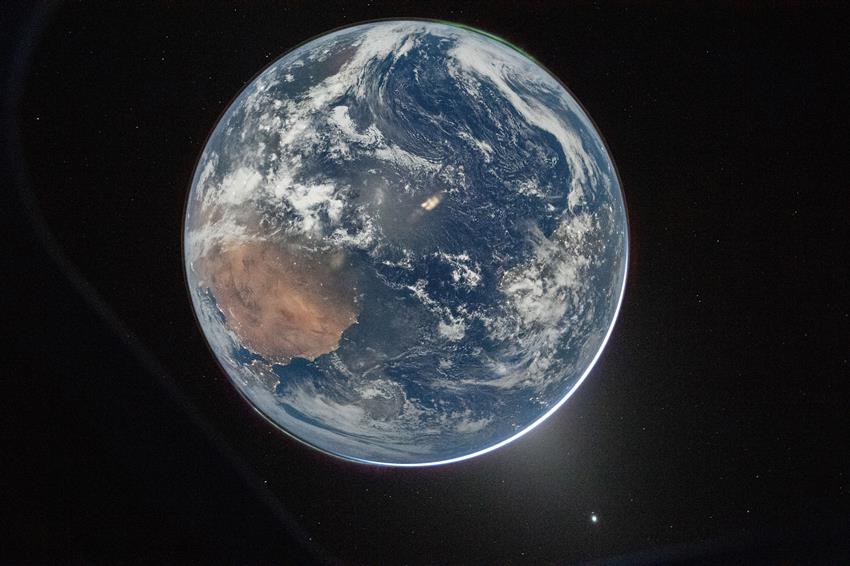
Planet Earth as seen from the Orion spacecraft.

Hello, world! This photo of Earth was taken by Artemis II Commander Reid Wiseman after the translunar injection burn was successfully completed. (Credit: NASA)

The first Canadian lunar capcom

CSA astronaut Jenni Gibbons was sitting to the right of the capcom during the TLI and exchanged a few words with her colleague and good friend Jeremy. She is the first Canadian certified as an Artemis capcom and will be on console several times during the mission, including during the Orion's lunar flyby on flight day 6. To support her colleagues, she will be able to draw on the geology field training she did in northern Labrador and in Iceland.

Staying fit and strong

During their day, the crew checked out the AVATAR scientific payload and successfully completed their first sessions on Orion's flywheel exercise device. The crew will use the system throughout the mission to demonstrate how astronauts can sustain aerobic conditioning and weight training in microgravity while also evaluating the hardware's performance in flight for future missions.

The flywheel supports both aerobic exercises and resistive movements. It operates much like a yo‑yo that can be adjusted to make exercises harder or easier. The flywheel can be used for activities like rowing and strength training like squats and deadlifts by generating up to 180 kilograms of resistance. This capability is especially important in deep space, where astronauts do not have access to the same extensive equipment as they do aboard the International Space Station. To maximize space, the flywheel is even placed under the door of Orion and acts as a step for the crew to get in and out. It weighs about 14 kilograms and is about the size of a carry‑on suitcase – meeting the strict mass and volume constraints of deep‑space missions.

On the horizon: Jeremy calls home

The first of three space-to-Earth video connections will take place overnight, in which Jeremy will speak live with Canadian youth, reporters and members of the public assembled at CSA headquarters. All three events will be livestreamed on the CSA's YouTube channel and Facebook account. During this first connection, Canadian media will have the opportunity to ask Jeremy their questions. The next events will take place on and .

A busy first day in space
Day 1 – 2nd entry
Ok

Canadian Space Agency (CSA) astronaut Jeremy Hansen launched aboard the Orion spacecraft atop the SLS rocket for the historic Artemis II mission. He will become the first Canadian to fly around the Moon. During their first day in space, the crew tested Orion's systems and performed key manoeuvres to prepare for their journey around the Moon. (Credits: CSA, NASA)

Transcript

Once they reached space, the crew got busy with cabin configuration tasks, checkouts and preparations for the next steps.

Placing the crew on a lunar free return trajectory

The apogee raise burn was successfully completed, refining Orion's orbit around Earth. The Interim Cryogenic Propulsion Stage (ICPS) ignited its engine for a precisely timed burn that increased the highest point of the spacecraft's orbit to eventually place the crew on a lunar free return trajectory in which Earth's gravity will naturally pull Orion back home after flying by the Moon.

Demonstrating Orion's manual piloting capabilities

Before the proximity operations demonstration, the crew removed the orange Orion Crew Survival System suit they wore for launch. They will only put their spacesuits back on ahead of the re-entry into Earth's atmosphere and the splashdown.

The crew then successfully completed the proximity operations demonstration, concluding one of the mission's early objectives and providing valuable data on how the Orion spacecraft performs during close‑range manoeuvring around another spacecraft. Over the course of the approximately 70‑minute activity, the crew guided the spacecraft through a series of controlled approach and retreat manoeuvres using the detached ICPS as a reference target.

At the conclusion of the demonstration, Orion executed an automated departure burn to safely separate from the ICPS, while the latter performed its own disposal burn to re‑enter Earth's atmosphere over a remote region of the Pacific Ocean.

During the departure, engineers used the spacecraft's docking camera to collect precise positioning measurements that will help refine navigation techniques for future rendezvous operations in the lunar environment, where GPS signals are unavailable.

Four international CubeSats, each twice the size of a shoebox, were deployed in high Earth orbit after the upper stage detached from Orion. From Germany, South Korea, Saudi Arabia and Argentina, the CubeSats will collect data for research on radiation and space weather, and measure the effects of the space environment on electrical components.

Checking out the systems

While the spacecraft is still close to Earth, the crew is assessing the performance of several critical systems, including:

  • the life support systems necessary to generate breathable air and remove the carbon dioxide and water vapour
  • the communication and navigation systems

They also fixed an issue with Orion's toilet, which was found during early checkouts.

Throughout the remainder of the trip, astronauts will continue to evaluate the spacecraft's systems, including demonstrating Earth departure and return operations, practising emergency procedures, and testing the radiation shelter.

A well-deserved nap

After an extremely busy period and the excitement of the launch, the crew had the opportunity to rest for about four hours. They woke up to perform a perigee raise burn to lift the lowest point of Orion's orbit around Earth. Together with the apogee raise burn completed earlier, these burns shape the spacecraft's initial orbit and prepare it for later translunar operations. With that milestone complete, they were able to go back to sleep.

To the Moon!

Earlier this afternoon, mission management determined that Orion's critical systems are in good enough shape to proceed tonight with the approximately six-minute translunar injection (TLI) burn that will accelerate Orion to escape Earth's gravitational pull and send it out of Earth orbit to begin its journey toward the Moon. To the Moon!

The start of a historic journey to the Moon
Day 1
Ok

Canadian Space Agency (CSA) astronaut Jeremy Hansen explains what to expect in the first 26 hours of the mission. (Credits: CSA, NASA)

Transcript

HE)

This is it, Canada! CSA astronaut Colonel Jeremy Hansen took flight today as part of Artemis II, the first crewed mission to the Moon in over 50 years, with his NASA crewmates Reid Wiseman, Victor Glover and Christina Koch. Jeremy Hansen will become the first Canadian – and first non-American – to fly around the Moon, making Canada the second country to send an astronaut on a lunar mission. He also becomes the 10th Canadian astronaut to fly in space on the CSA's 18th mission.

The Artemis II crew launched aboard the Orion spacecraft on the Space Launch System rocket from Kennedy Space Center in Florida at ET. It took them a little over eight minutes to reach space.

In a statement released after the launch, the Right Honourable Mark Carney, Prime Minister of Canada, said:

"This moment reminds us of what Canada has always been: a nation of explorers, builders, and innovators. Colonel Hansen carries forward the legacy of those who came before him – Marc Garneau, Roberta Bondar, Chris Hadfield – and the dreams of every young Canadian watching today's launch."

Canada proud

Canadians across the country assembled in watch parties in science centres, universities, communities and with family and friends at home to watch the historic launch. Many shared their pride on social media platforms.

At the CSA's headquarters, government officials, various guests, employees and media attended the CSA's livestreamed event hosted by astronaut David Saint-Jacques and Senior Engineer Kumudu Jinadasa. In Ottawa, other government officials and members of the Canadian space industry followed the launch from the Canada Aviation and Space Museum.

An important Canadian delegation led by CSA President Lisa Campbell that included key stakeholders from government, industry, academia as well as family and friends of the Hansens travelled to NASA's Kennedy Space Center in Florida to watch the launch live. Retired Canadian astronauts as well as the next Canadian slated for launch, CSA astronaut Joshua Kutryk, were also on site to cheer Jeremy on.

Explore further

Date modified: