
Artemis II: Scientific research during the mission
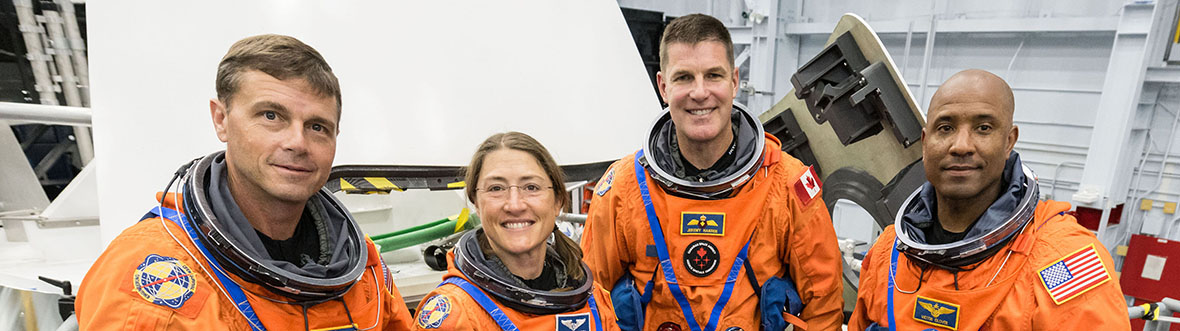
The crew of Artemis II: Four astronauts ready for anything. (Credit: NASA/David DeHoyos)
Artemis II is the first crewed flight in NASA's Artemis program and a critical step toward establishing a sustainable human presence on the Moon and preparing for future missions to Mars.
Focusing on astronaut health
During their mission to the Moon, the Artemis II astronauts served as both scientists and research subjects, participating in five studies that explored how deep-space travel affects the human body, mind and behaviour. These experiments are essential for keeping astronauts healthy on longer missions and for developing technologies, protocols and preventive measures.

An organ chip device to study the effects of increased radiation and microgravity on crew health. (Credit: Emulate)
1. ARCHeR (Artemis Research for Crew Health and Readiness)
ARCHeR is a cutting-edge study that monitors astronauts' sleep patterns, stress levels, cognitive performance, and teamwork dynamics using wearable wristbands. These devices collect real-time physiological and behavioral data, helping researchers understand how isolation, confinement, and the unique environment of deep space affect crewmembers. Unlike missions in low Earth orbit, deep-space missions involve longer durations and greater psychological stressors, making this research vital to optimize human performance for future exploration.

A NASA astronaut inside the ISS holding a colour calibration strip and sample bag, showcasing saliva-based diagnostic research for Artemis missions. (Credit: NASA)
2. Immune Biomarkers
Spaceflight can alter the immune system, potentially increasing susceptibility to illness. The Immune Biomarkers study investigates these changes by analyzing blood samples collected before and after the mission, and saliva samples collected during the mission. In space, astronauts collect saliva using specialized paper in pocket-sized booklets to preserve wet spit since refrigeration and other equipment won't be available on board. These samples help scientists identify biomarkers that signal immune system changes due to increased stresses of radiation, isolation and distance from Earth, contributing to the development of countermeasures to keep astronauts healthy. They also examine whether otherwise dormant viruses are reactivated in space, as has been seen previously on the International Space Station (ISS) with viruses that can cause chickenpox and shingles.
3. AVATAR (A Virtual Astronaut Tissue Analog Response)
AVATAR uses organ-on-a-chip technology roughly the size of a USB thumb drive, a revolutionary method that mimics human tissue function on a micro scale. By incorporating cells developed from preflight blood donations provided by crewmembers into these chips, researchers can simulate how deep-space stressors like microgravity and extreme radiation affect human organs. Bone marrow plays a vital role in the immune system and is particularly sensitive to radiation, which is why scientists selected it for this study. This approach allows for detailed, controlled studies of tissue responses without needing invasive procedures, paving the way for personalized medicine in space. In fact, AVATAR could inform measures to ensure crew health on future deep-space missions, including personalizing medical kits to each astronaut. For people on Earth, it could lead to advancements in individualized treatments for diseases such as cancer.
4. Standard Measures
Since , this investigation has been collecting data from participating crewmembers before, during, and after missions aboard the ISS – and Artemis II marked the first time astronauts in deep space took part. The goal is to build a comprehensive picture of how spaceflight impacts the human body by tracking physiological changes over time and identifying trends that could inform training, rehabilitation, and mission planning.
The crew provided biological samples including blood, urine, and saliva for evaluating nutritional status, cardiovascular health, and immunological function six months before their launch. The crew also participated in tests and surveys evaluating balance, vestibular function, muscle performance, changes in their microbiome, as well as ocular and brain health. While in space, data gathering included an assessment of motion sickness symptoms. After landing, there are additional tests of head, eye, and body movements, among other functional performance tasks. Data collection will continue for a month after their return.
5. Radiation monitoring
Space radiation poses one of the greatest risks to astronaut health, especially during missions beyond Earth's protective magnetic field. Radiation monitoring involved tracking exposure levels using six active radiation sensors deployed at various locations inside the Orion crew module. The crew also carried dosimeters in their pockets. The sensors could provide advanced warning if the crew had needed to shelter to protect from radiation exposure due to solar storms.

Canadian Space Agency astronaut Jeremy Hansen photographs a 3D model of the Moon suspended by a crane inside a NASA facility during Artemis II preparations. (Credit: NASA/James Blair)
Observing the Moon – for science!
A basketball held at arm's length – that is what the Moon looked like to the Artemis II crew when Orion flew at their closes approach from the Moon's surfac. They were also the first humans to see, with the naked eye, parts of the Moon's far side – the side that always faces away from Earth. With real-time data analysis and guidance provided by a team of scientists with expertise in impact cratering, volcanism, tectonism, and lunar ice, the crew observed and photographed geological features like impact craters, ancient lava flows, and regions like the Orientale Basin. These observations will:
- help scientists understand the ancient geologic processes that shaped the Moon and our solar system
- support future surface missions like Artemis III, which will land near the Moon's South Pole – a region rich in ancient rocks and water ice
The Artemis II astronauts used their geology training to describe surface textures, shapes, and colours, providing valuable data for future exploration of the Moon. They also witnessed meteoroid impacts, dust levitation, and a solar eclipse.

The Artemis II prime and backup astronauts take lunar geology training in Iceland. (Credit: NASA/Robert Markowitz)
International science
National space organizations from Germany, South Korea, Saudi Arabia, and Argentina collaborated with NASA to fly CubeSats aboard Orion. The CubeSats have their own science objectives, distinct from those of the Artemis II mission. In addition to the CubeSats, the German Aerospace Center conducted radiation research.
- TACHELES CubeSat, German Aerospace Center: Measures the effects of the space environment on electrical components to inform technologies for lunar vehicles.
- K-RadCube, Korea AeroSpace Administration: Uses a dosimeter made of human-like tissue to measure space radiation and biological effects across the Van Allen radiation belts.
- Saudi Space Agency CubeSat: Deployed in high Earth orbit to collect data on space weather at a range of distances from Earth.
- ATENEA CubeSat, Argentina's National Space Activities Commission: Assesses radiation shielding methods, measures Earth's radiation spectrum, collects GPS data and validates a long-range communication link.
The size of two shoeboxes, the CubeSats will rode to space inside a ring that connects NASA's Orion spacecraft to the upper stage of the SLS rocket. They were deployed in high Earth orbit after the upper stage detached from Orion.

Technicians install the Korea AeroSpace Administration (KASA) K-RadCube within the Orion stage adapter. (Credit: NASA)
Looking ahead
Artemis II is a stepping stone is the Artemis campaign, develop a sustained presence on the lunar surface. The data collected will help scientists understand the Moon's geology and prepare for future missions to Mars.
Canada's involvement ensures our place in shaping the future of space exploration – from Earth orbit to the lunar surface and beyond.