
AstroFit: Building strength on Earth and in space
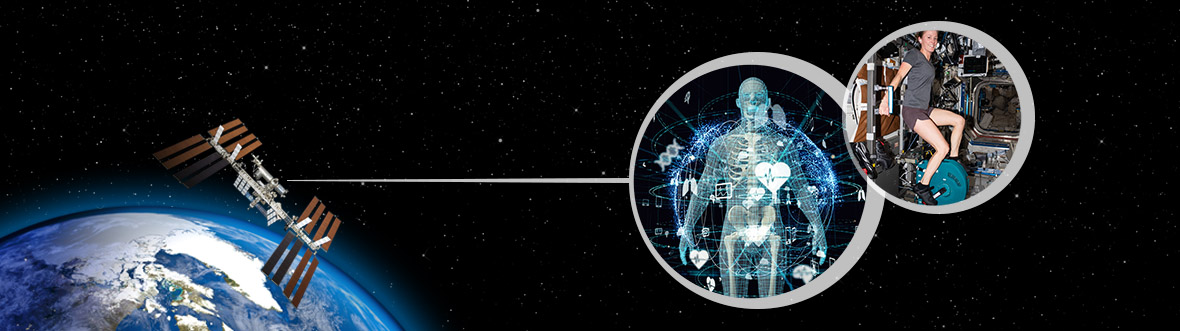
AstroFit aims to improve astronauts' exercise routine to help lessen the effects of microgravity on their bodies during long-duration spaceflight.
Background
Space missions are hard on the human body. On Earth, gravity provides resistance to our muscles and bones, and this keeps us strong enough to support our own weight. In microgravity, however, bones and muscles no longer need to support the weight of astronauts' bodies. As a result, astronauts experience bone and muscle loss, stiffening of the arteries, increased insulin resistance and changes to cardiovascular health, among other things.
While in space, astronauts must stick to intensive exercise training schedules to help offset these effects. AstroFit is an exercise protocol that will break prolonged periods of inactivity through three separate periods of exercise per day, including light, continuous or high-intensity interval training (HIIT), and resistance exercises.
AstroFit was first put to the test on Earth with a bed rest study, which is a way of mimicking the microgravity environment that astronauts experience in space. The participants lay in bed for 14 days with their heads tilted slightly down, and half of them did the three daily exercise sessions using adapted equipment.
The findings of the bed rest study confirm the benefit of AstroFit in attenuating an increase in insulin resistance while maintaining aerobic fitness and muscle volume in comparison to a control group who did not train with AstroFit.
The next step is to test AstroFit on the International Space Station (ISS).
Objectives
AstroFit aims to:
- reduce the impact on the body of prolonged exposure to microgravity, including insulin resistance
- use HIIT in combination with aerobic and resistance training to maintain fitness while in microgravity
- reduce the rapid aging-like changes of long-duration spaceflight
- evaluate the use of this type of exercise for future missions as well as on Earth
Impacts on Earth
The knowledge we gain from AstroFit could have an impact on people on Earth who are bedridden due to injury, illness or frailty. Insulin resistance, stiffing of the arteries and bone density loss are all effects of inactivity or aging that can be studied in the microgravity environment of the ISS to better understand how to lessen the effects on Earth.
How it works
- Eight astronauts will follow the AstroFit exercise protocol while on the International Space Station. Researchers will gather baseline physical health data from the participants before their mission. They will then gather data during and after the mission to compare.
- Researchers will compare this data to data from a control group of eight astronauts who did not use the AstroFit protocol during their spaceflight.
Participants will wear the Bio-Monitor, a Canadian-made innovative smart shirt system designed to measure and record astronauts' vital signs, during part of the AstroFit protocol.
Timeline
Data collection is set to begin in fall and is scheduled to conclude in .
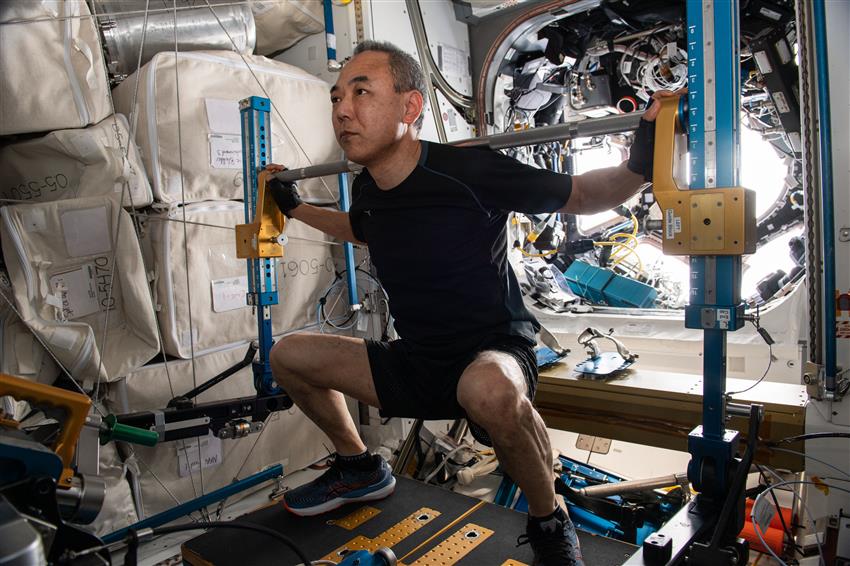
JAXA astronaut Satoshi Furukawa does squats aboard the ISS. (Credit: NASA)
Research team
Principal investigator
- Dr. Richard Hughson, Schlegel-University of Waterloo Research Institute for Aging, FRSC, FCAHS
Research manager
- Dr. Andrew Robertson, Schlegel-University of Waterloo Research Institute for Aging