
A clearer view of Earth: How a Canadian company is helping Europe monitor the climate
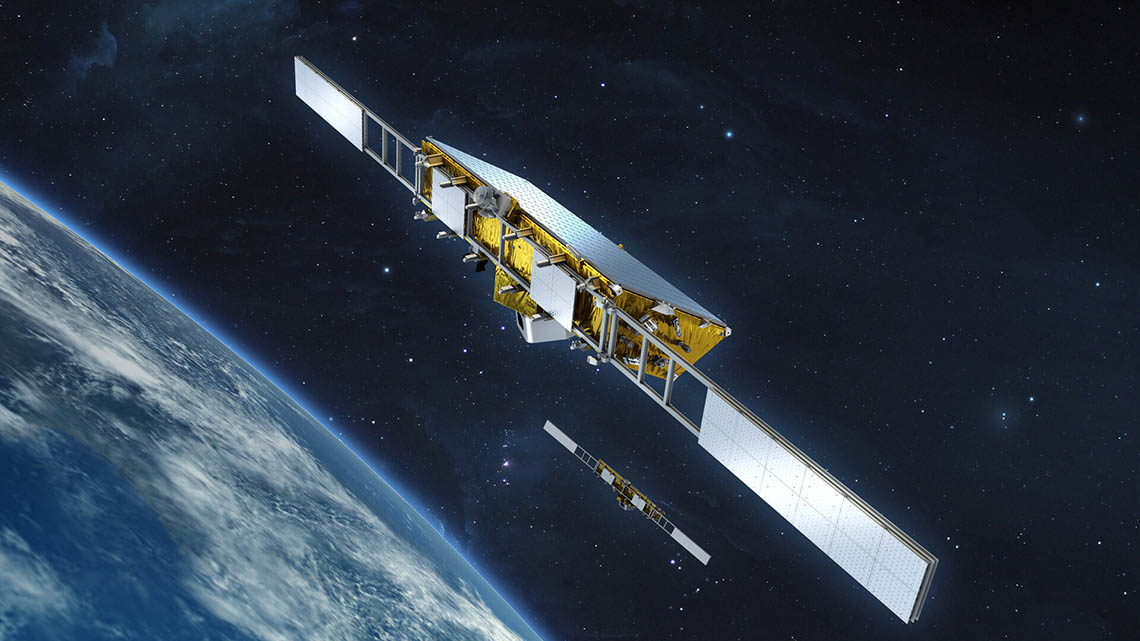
An artist's impression of the Harmony satellites: Their aim is to observe small-scale movement and deformation fields of the ocean surface, glaciers and ice sheets, sea ice and the solid Earth. (Credit: OHB)
Since , Canada has held the unique status of being the only non-European cooperating state of the European Space Agency (ESA). Through the Canada–ESA Cooperation Agreement, Canadian companies gain access to ESA programs and opportunities, opening the door to Europe's space market and fostering international success stories.
Over the last few years, ABB's business unit in Quebec has gradually carved out a reputation as a global leader in space optics. And their expertise is now taking centre stage in the European Space Agency's (ESA) Harmony mission – a collaboration made possible thanks to the Canadian Space Agency (CSA).
ABB's advanced thermal imaging cameras will take on a vital role in Harmony, a mission part of ESA's FutureEO program that is designed to better understand climate change and natural disasters. This technology goes beyond satellite imagery: the cameras can capture precise temperature data from multiple angles. For example, these cameras can capture thermal information from both sides of a building – such as a skyscraper's sunny and shaded walls – rather than just the rooftop. This capability, complementing radar data from other instruments, allows Harmony to track temperature changes, cloud movement and the dynamic relationship between Earth's surface and atmosphere in a novel way.
ABB's work on Harmony, enabled by the Canada–ESA Cooperation Agreement, marks a major achievement for the company. It will sustain up to 50 highly skilled jobs in Canada and help grow national expertise in thermal imaging, electronics, and radiometric calibration.
But the impact goes even further. With over 35 years of experience contributing to missions led by NASA, ESA, and the Japan Aerospace Exploration Agency, ABB's position on the world stage is expanding. Thanks to Harmony, the company is now poised to work with emerging space agencies around the world – particularly those looking to access top-tier thermal imaging technology.
How Canada helped make it happen
By investing in ESA's Earth observation programs, the CSA paved the way for Canadian companies to connect with European partners and to gradually take on increasingly ambitious roles. Indeed, ABB's collaboration with ESA didn't begin with Harmony. It started back in the 1990s with the Envisat mission and has grown steadily ever since.
Through funding programs like the Space Technology Development Program, the CSA supported ABB as it developed its radiometric calibration expertise. This led to a patented technology that has since become a benchmark in Europe temperatures measurements from space. ABB also led the Atmospheric Chemistry Experiment on Canada's SCISAT mission, launched in 2003, a turning point that propelled the company into the space sector.
Ripple effects across the Canadian space ecosystem
ABB's work on Harmony is the tip of the iceberg. The company is contributing to other ESA climate missions like FORUM and LSTM, both of which provide vital climate data. ABB is also applying its expertise to the ARIEL astronomy mission, where the team is tackling complex technical challenges such as managing compatibility of instruments in a challenging range of temperatures (between −230 °C and 20 °C).
These successes are sending ripples across Canada's space sector. ABB is now working with companies like GHGSat, EarthDaily Analytics, and Hydrosat, creating new jobs and contracts for small and medium tech companies. This is proof that when Canadian expertise is part of the mission, the impact extends beyond a single organization.