
The power of space: "That is what I am going to do someday"
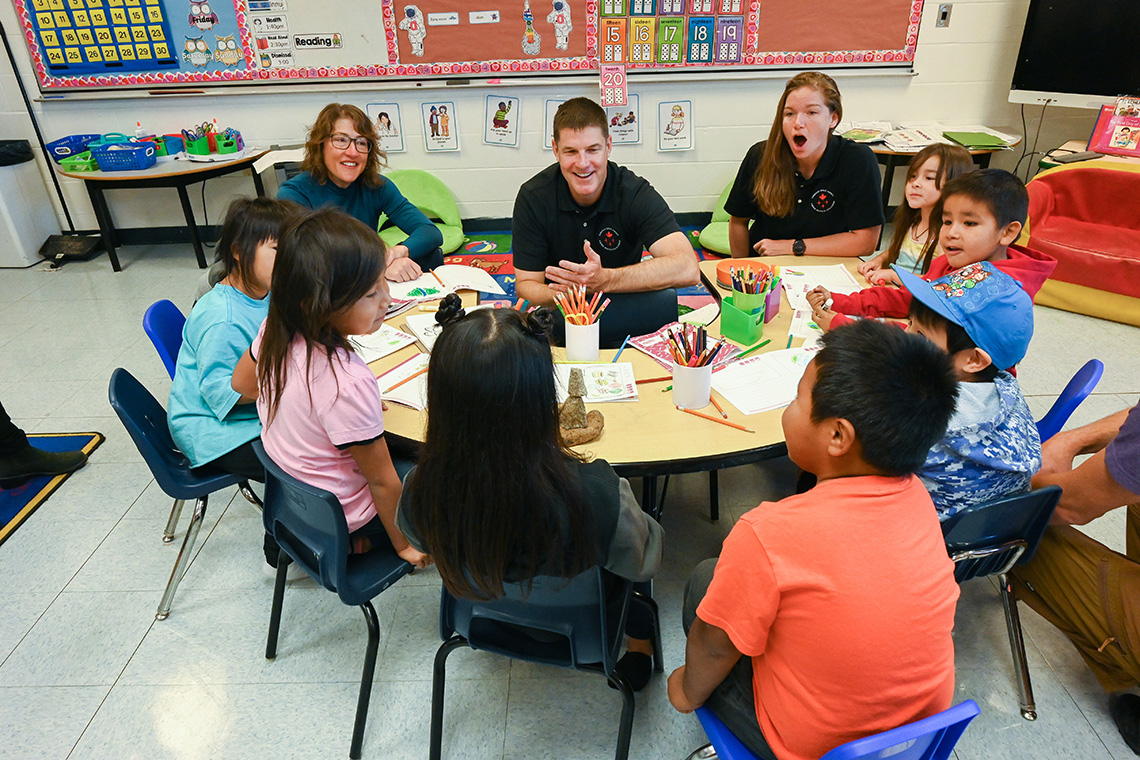
NASA astronaut Christina Koch as well as Canadian Space Agency (CSA) astronauts Jeremy Hansen and Jenni Gibbons share a moment with young Innu students at Mushuau Innu Natuashish School. (Credit: CSA)
"I remember looking at photos of humans on the Moon as a young child and then staring up at the Moon in the night sky and realizing people had been there. From that point forward I was looking in my school library for books on space and it was all about building bases on other planets and travelling to other planets. I thought, 'That is what I am going to do someday.'
I turned my treehouse into a rocket ship. I had dials and circuit breakers for switches and all sorts of stuff. I was really exploring space at a young age, because of the fact that I saw that humans had left our planet and walked on the Moon. I still think today that it is the coolest thing."
- Jeremy Hansen, CSA astronaut and first Canadian around the Moon as Artemis II crewmember
Space has always been a source of wonder. It has fed the imaginations of writers, artists, but also kids – younger and older – for decades. Generations of space experts, like Jeremy Hansen and many scientists and engineers at the Canadian Space Agency (CSA), say that images of astronauts walking on the Moon, hearing an astronaut speak in their school gym, watching a rocket launch, seeing the Canadarm deploy on live television or even our Canadian robots Canadarm2 and Dextre displayed on the $5 bill influenced the study or career path they chose later in life.
Preparing the next generation
The CSA uses space to inspire young Canadians to study science, technology, engineering and mathematics (STEM) and support the development of highly qualified personnel.
But STEM education is not only about acquiring technical skills. It fosters critical thinking, problem-solving, and creativity. Increased science literacy improves our country, as it is the backbone of innovation and economic growth. It helps prepare the next generation of Canadians for our rapidly evolving world.
In -, the CSA reached over 145,000 Canadians, including well over 85,000 Canadian youth through meaningful hands-on activities, speaker presentations, kiosks, collaborations and other initiatives.

Joshua Kutryk speaks to students at Two Hills School, Alberta, which he attended as a child, to share his passion for space and talk about his upcoming mission. (Credit: Two Hills School)
It takes a village
To raise awareness of space and reach as many learners as possible, including groups underrepresented in STEM,Footnote 1 the CSA collaborates with organizations to design exciting learning initiatives, but also leverages existing programs across the country. Here are some examples:
- In fall , about 500 Lunar Adventure Kits were delivered to eight Nunavut communities and an Ottawa-based group serving Inuit youth that co-developed the kits. This resource about growing food in Nunavut and in space blends Western science concepts with local knowledge and cultural principles of Inuit peoples.
- "Everyone was really engaged and invested in the activity, and it has really sparked an interest in space, the Moon, and science," said a teacher whose students were involved in the Rover Driving Academy, run by Mission Control.
- About a workshop on lunar geology and finding water on the Moon organized with Bibliothèque et Archives nationales du Québec, another teacher mentioned, "Students showed great interest during the preparatory phase and the talk. They especially appreciated the part proposed in game format. Space is a subject that students this age really like."
Collaborations such as these are key to ensuring that young Canadians in all provinces and territories have access to high-quality space learning experiences that inspire and empower them to contribute to a rapidly growing space sector and our nation's innovative spirit.
Thank you to our precious collaborators!
Let's Talk Science, Actua, Ulnooweg Education Centre, West Island Black Community Association, Makigiaqta Inuit Training Corporation, Mission Control, NASA, Exploring by the Seat of Your Pants, École en réseau, Environment and Climate Change Canada, Bibliothèque et Archives nationales du Québec, Orchestre métropolitain, Agriculture in the classroom, science centres and museums, and many more!